

Law firm web design
Someone looking for a solicitor is usually having a bad week. They are anxious, comparing two or three firms on a phone, and deciding who feels safe to ring. Your website is that decision.
People choosing a lawyer are usually under stress and judging credibility fast. We build calm, authoritative law firm sites that explain your practice areas plainly, build trust, and rank for the people searching for a solicitor near them.
What holds most law firm websites back
- One page covers every practice area. Family, conveyancing, wills, commercial and criminal all sit in a single list, so the site ranks for none of them and reassures nobody.
- The lawyers are a grid of headshots with no profile pages. People search for a named solicitor before they call. If there is no page, someone else gets the visit.
- Nothing answers the question the person actually typed. They searched for what happens next, how long it takes, or what it costs, and the site talks about the firm's heritage instead.
- No indication of cost anywhere. Fixed-fee conveyancing and a free first consultation are the two things most enquirers are hunting for, and most firms hide both.
One page per practice area, not one page for all of them
This is the single biggest structural failure on law firm websites. A combined services page cannot rank for family law, conveyancing, wills and estates, employment and commercial litigation at once. They are different searches by different people with different urgency.
Each practice area needs its own page, written for the person in that situation. Someone facing a property settlement and someone drafting a will are not the same reader and should not land on the same page.
It compounds with location. Most legal search is local, and the person is typing a practice area plus a suburb. A firm with proper practice area pages can serve that. A firm with one services page cannot.
Lawyer profiles are pages, not headshots
People check the person, not just the firm. They want to know who will handle the matter, how long they have practised, what they focus on, and whether they hold accreditation in the area.
A profile page carrying admission year, practice focus, accredited specialist status, professional memberships and a direct way to make contact does two jobs. It reassures the anxious reader, and it ranks when someone searches the solicitor by name, which they routinely do after a referral.
Answering the question is the marketing
Most people research before they ring. They want to know how long probate takes, what happens at a first family law appointment, or what conveyancing actually costs. Firms that answer those questions plainly get found and get trusted.
This matters more now that a growing share of people ask an AI assistant first. Assistants quote pages that answer a question directly and clearly. A page of firm heritage gives them nothing to quote. A page that answers the question gets cited.
None of this is giving legal advice on your behalf. It is explaining process, timeframes and what to expect, which is what the enquirer is trying to find out before they commit.
Advertising rules, handled properly
Legal advertising in Australia is regulated, and personal injury advertising in particular is restricted in some states. Any firm touching that work needs a website built with those constraints in mind rather than retrofitted after a complaint.
In practice that means care with claims, outcomes and testimonials, and keeping the site consistent with your professional obligations. We build to the constraints you tell us apply. We are not lawyers and do not advise on compliance, so your firm confirms the position and we build to it.
Concept build
A law firm site we designed from scratch
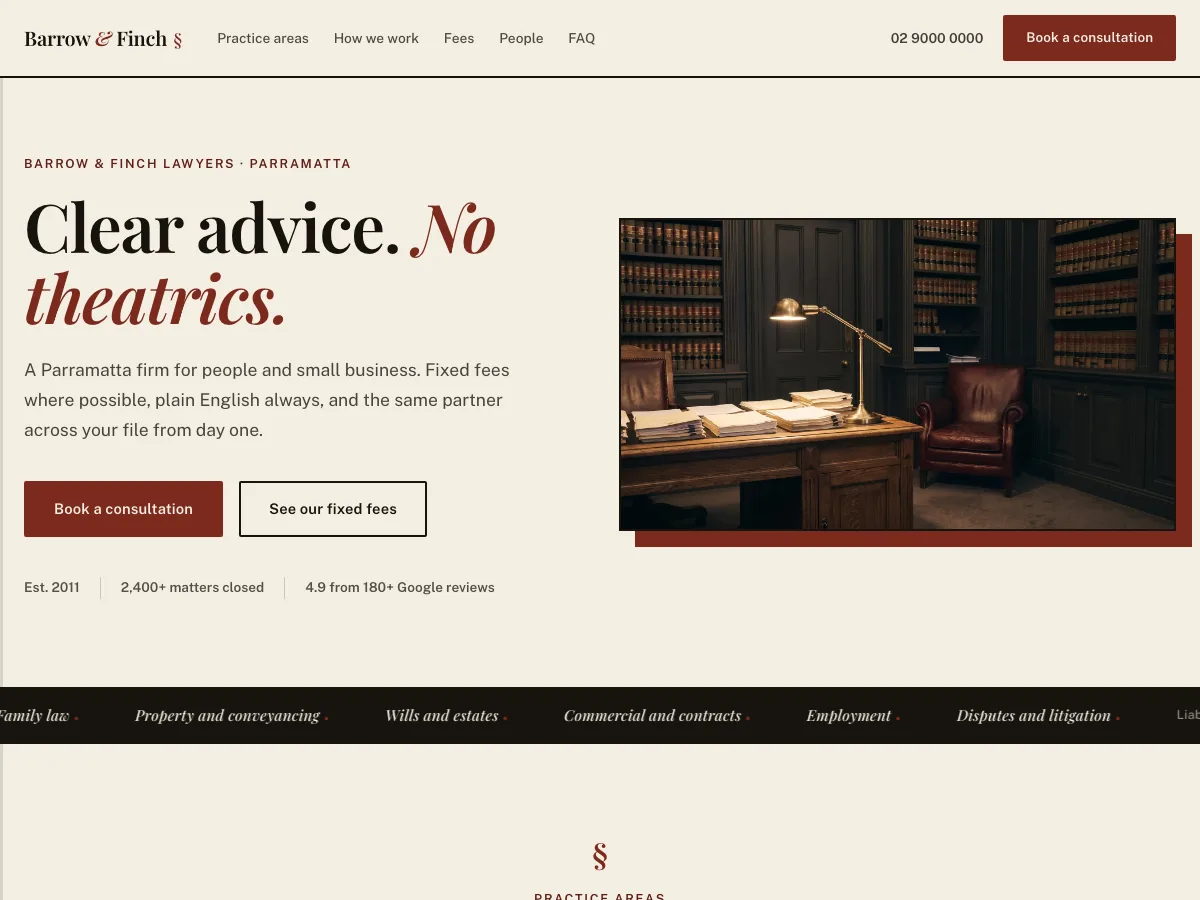
A legal letterhead at poster scale. Ink, bone and oxblood, clause-numbered sections and a signature that signs itself.
Barrow & Finch Lawyers is a fictional business we invented so we could design a complete law firm site end to end, without a client brief limiting it. It is a real, working site you can click through, not a mockup or a theme you can buy. Yours would be shaped around your trade, your suburbs and your customers.
What's included in every build
Every site starts with proper research. That shapes everything else.
Keyword research first
Before writing a word of copy we find what law firms and solicitors actually search for locally and nationally. The site is built around those terms, not around what sounds good in a meeting.
Mobile-first build
Most enquiries for law firms come from a phone. Every site we build loads fast on mobile, looks clean at every screen size and makes contacting you as easy as one tap.
Copy that converts
We write the copy. Short, plain sentences that explain what you do, for whom, and what to do next. No filler, no buzzwords. Written for law firms and solicitors clients, not search engines.
Google Business Profile
The website and the profile are built from the same keyword data. Your profile gets a proper description, services, posts and photo guidance so it surfaces in the local pack and on Maps.
Speed and technical basics
Correct meta titles and descriptions, structured data, sitemap and a build that passes Core Web Vitals. The foundations that make everything else work.
Ongoing support
You get a handover, documentation and the option to keep us on monthly for updates and Google Business Profile management. No lock-in. No retainer you don't need.
One operator, not an agency
Most web design agencies have a sales team, a project manager and a developer who you'll never speak to directly. You brief the sales person, the project manager translates it (partially), and something gets built that may or may not reflect what you asked for.
I do the research, write the copy, build the site and set up the Google Business Profile. One person, accountable for all of it. No handoffs, no miscommunication, no junior doing the work the senior sold.
I've spent 30 years in business, mostly in trade and distribution. I understand what law firms need from a website because I understand how businesses like yours actually work. That background shapes everything from the structure of the page to the words in the meta description.
More about Chris and how I workPackages and pricing
Three ways to work together. No lock-in. No hidden extras.
Refresh
From $1,950
Take an existing site and rework it: new copy, better structure, meta and schema fixed, Google Business Profile updated.
Rank-built
From $2,950
Research-led build from scratch. Keyword research, full copy, mobile-first design, schema, Google Business Profile setup.
Get Found monthly
From $199/mo
Ongoing Google Business Profile management, content, posts and reporting. Add to any package or as a standalone.
Common questions
- Why does each practice area need its own page?
- Because they are different searches by different people. Someone looking for a conveyancer and someone looking for a family lawyer will never type the same thing, and a single combined services page cannot rank for both. One page per practice area, each written for the person in that situation, is the change that moves the most.
- Do you build individual profile pages for each solicitor?
- Yes, and they matter more than most firms expect. People search for a solicitor by name after a referral, and they want to see admission year, practice focus, accreditation and memberships before they ring. A profile page ranks for that name search and answers the trust question at the same time.
- Can you work within legal advertising restrictions?
- Yes. Legal advertising is regulated in Australia and personal injury advertising is restricted in some states, so we build to whatever constraints your firm confirms apply. We are not lawyers and do not advise on compliance. You tell us the position, we build the site to respect it.
- Should we publish our fees?
- For fixed-fee work such as conveyancing and simple wills, usually yes. It is one of the most searched things in legal and one of the least answered, so publishing it wins enquiries from firms that stay silent. For matters that genuinely cannot be priced up front, explain how you charge and what the first consultation covers.
- How do you get a law firm website ranking locally?
- Practice area pages combined with location, then a properly optimised Google Business Profile. Most legal searches carry a suburb or region, and the map pack sits above the organic results. The website and the profile are built from the same keyword research so they reinforce each other.
- What does a law firm website cost?
- A refresh of an existing site starts from $1,950 and a research-led build from scratch starts from $2,950. Firms needing a page for every practice area plus profiles for each solicitor are quoted after a scoping call, since the page count drives the work. Ongoing Google Business Profile management is from $199 per month.
Ready to get your law firm website working?
Start with a free look at your current site and Google Business Profile. No obligation, no sales call. Just a straight assessment of what's working and what isn't.
Also see: Website design services, Packages and pricing